
39% of today’s workplace skills may be obsolete by 2030, according to the World Economic Forum. With this pace of change, organisations need learning environments that help employees continuously adapt and apply new knowledge in real time. Formal learning still provides the structure and foundational knowledge every organisation depends on. But to keep capability growing, it needs to be supported by collective learning where people connect and co-create knowledge together.
At Totara, we see this blend as the foundation of resilient learning cultures. It’s why we’re exploring how organisations can design collective learning that is both structured and social, enabling employees to learn from one another as well as from formal programmes. To help with this, we invited Anamaria Dorgo, learning consultant and founder of L&D Shakers, to share her knowledge with our Totara Community as a specialist in building communities
This article is part three of Totara’s social learning series. Part one, featuring Charles Jennings, explored how collaboration drives continuous development. Part two showed how Mitchells & Butlers used their Totara LMS to create safe, scalable social learning spaces. In this final part, we look at how to design collective learning experiences that bring people together, sustain engagement, and turn shared learning into lasting performance.
Why organisations need social learning to keep pace with change
L&D teams are rightly moving from being content publishers to becoming enablers of performance through rich learning ecosystems, while the shelf life of skills continues to shrink. Formal learning still matters because it sets standards and supports compliance. The challenge is helping people keep developing between and after courses, when the real work happens.
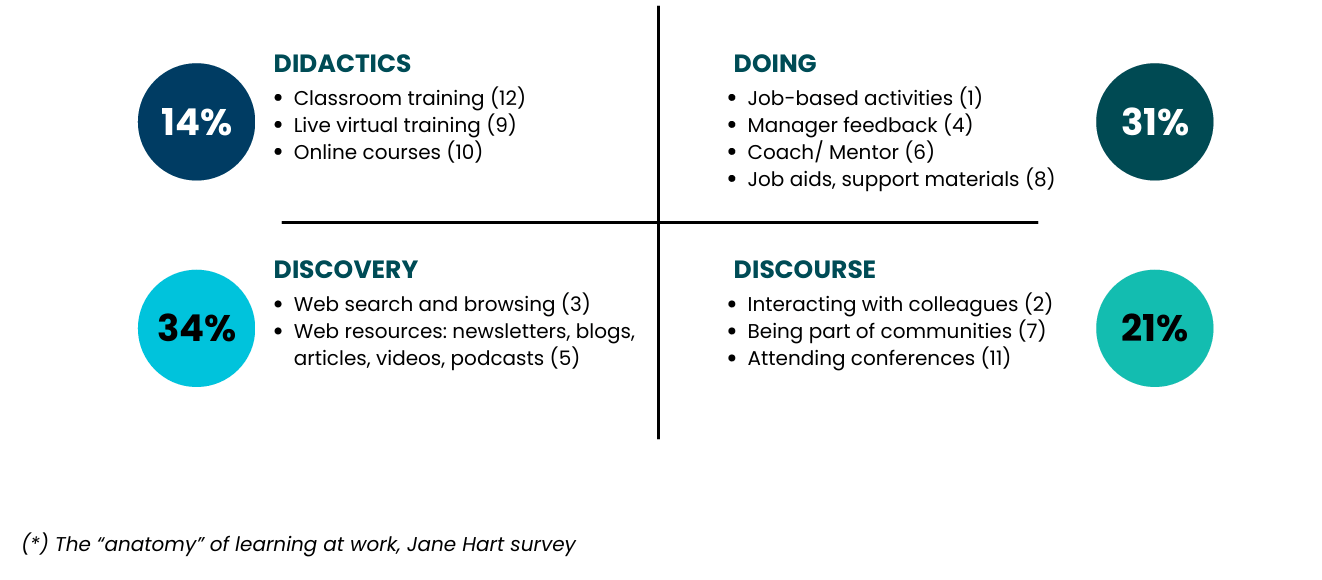
Several signals point to this shift. One comes from Jane Hart’s long-running survey on workplace learning behaviours, which asks employees how they learn best at work. Although formal learning remains important, respondents often place greater emphasis on learning through Doing, Discovery, and Discussion.
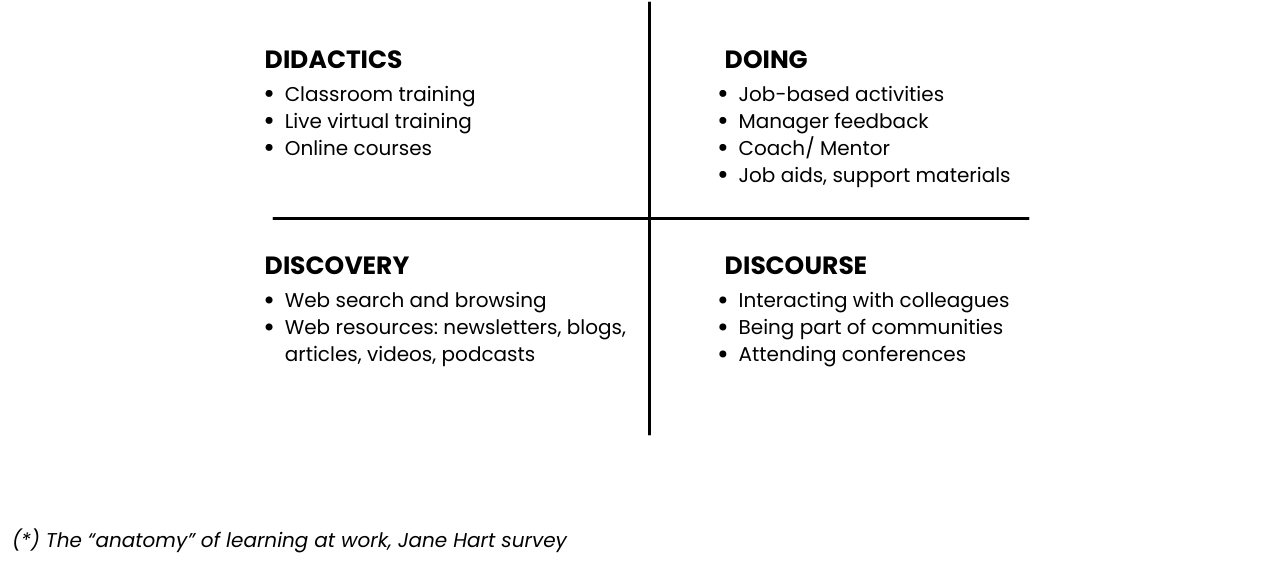
Across thousands of responses, Didactics were reported at 14%, compared with 31% for Doing (job-based activities, manager feedback, coaching), 34% for Discovery (web search, articles, videos, podcasts), and 21% for Discourse (interacting with colleagues, communities of practice).
Anamaria Dorgo emphasises that in a complex environment, relying on a single perspective is limiting. Collective learning allows organisations to tap into diverse viewpoints and problem-solving approaches that no individual could provide alone. When people learn together, they build capability faster and adapt more effectively to new challenges.
Types of social learning in the workplace
Collective learning is not a single activity but a range of approaches that bring people together to share knowledge and build skills. Understanding these different forms helps L&D teams design experiences that match their organisational needs.
Peer learning
Peer learning happens when equals support each other and learn from one another. Examples include action learning sets, peer circles, communities of practice, show and tell sessions, lunch and learn events, peer coaching circles, internal podcasts, and book clubs. These formats work well when employees need space to share experiences, ask questions, and develop together without hierarchy.
Collaborative learning
Collaborative learning involves peers working together towards a shared goal to produce or solve something collectively. This could take the form of hackathons, group project-based learning, team retrospectives, garage sessions, incubators, or use case libraries. The purpose here is not just to learn but to create something, with learning happening as a natural part of the process.
Mentoring and guided social learning
Guided social learning involves learning from someone more experienced, such as a mentor, senior colleague, or expert. Examples include one-to-one mentoring, coaching, expert show and tell sessions, ask-me-anything sessions, case clinics, expert panels, lightning demos, shadow-the-manager days, and expert critique sessions. These approaches help employees access knowledge that might otherwise be difficult to reach.
Informal social learning in organisations
The broader category of social learning includes any learning through observation or interaction with others. This often happens informally through job shadowing programmes, apprenticeships, job swaps or short rotations, a day in the life programmes, role plays with feedback, call-listening sessions, or analysing business cases in training and debating options together.
How organisations are implementing collective learning successfully
Organisations across industries are applying these principles in different ways. In her session, Anamaria highlighted three examples that show how collective learning can be designed to fit organisational culture and business needs.
Bosch: Working Out Loud community
Bosch created an open community on their internal digital collaboration platform called Bosch Connect, with more than 1,200 members who joined organically. The Working Out Loud concept involves small groups of four to five people coming together over 12 weeks to work through challenges and activities. Each group has a facilitator, and facilitators themselves have access to a support community. The platform hosts the circle registration form, media materials, events, activities, and helpful resources in a shared wiki. This approach scaled across the organisation without heavy central coordination.
Stuart: Ambassador programme
Stuart developed a gamified programme that allows employees to get involved in activities outside their normal role while building relationships with peers. Employees can choose from a menu of options: host a Stu-Talk, become an onboarding buddy, join a coffee roulette to talk with someone outside their department, become a mentor, or get involved in local committees or employee resource groups. The programme is incentivised with prizes, making participation visible and rewarding.
Novartis: Curiosity Month
Novartis launched a company-wide event to encourage learning beyond formal L&D offerings. It started with a crowdsourced ideation event that generated 13,000 ideas. Over 1,000 volunteers organised a month-long event on curiosity, hosting 500 events that reached 55,500 people globally and generated 145,000 learning hours. The success of the initiative led Novartis to allocate 5% of employee time, approximately 100 hours per year, for self-directed learning, curiosity, and development.
These examples show that collective learning works when it is designed around employee interests, supported by clear structures, and given room to grow organically.
Three design principles for sustainable communities
Anamaria Dorgo’s work with communities of practice has identified three core principles that make collective learning sustainable and effective.
Have a clear purpose: why do we gather and who do we gather?
Collective learning only works when people understand why they are coming together and what they hope to achieve. Design should start with a common challenge or goal that is informed by strategic direction.
Two questions help define this purpose:
- What business challenges can we solve together?
- What impact do we want to have?
The purpose sits at the overlap of two areas: the expected value for the organisation (what stakeholders want) and the expected member value (why individuals should care). When both are clear, people understand why participation matters.
For organisations where the culture is not yet ready for large-scale social learning, Dorgo advises starting small. Pilot collective learning by adding it to an existing project or programme.
Relentlessly focus on the value that is created
Purpose informs activity. Once the purpose is clear, ask: if this is our goal, what needs to happen when we come together to make progress towards it?
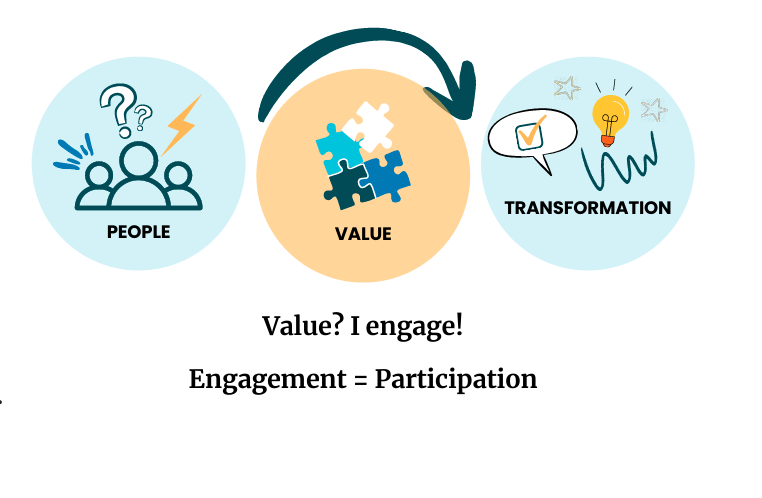
Dorgo breaks collective learning into three components:
- People: The group engaging in the learning
- Transformation: The change or purpose they are working towards
- Value: The activities and design that connect people to the transformation
When engagement is low, the problem usually sits in one of these three areas. Either the wrong people are involved, the transformation is unclear, or the activities do not help people make progress. Dorgo emphasises that engagement is not something to hack or engineer. “Engagement is participation. There’s value? I engage. No value? Not participating.”
Experimentation is a must. Listen carefully to feedback, gather data on what works, and be willing to stop activities that do not create value.
Co-create it: the only way to build sustainably
In ideal conditions, with the right culture and psychological safety, social learning emerges organically. But to build it sustainably and at scale, co-creation is necessary. L&D teams create the container and set the conditions where learning can happen, but they do not dictate every detail.
Dorgo uses a framework built around five elements:
- Purpose: Why is this work important for you, us, and the larger organisation? (“We exist to…”)
- Principles: What rules and rituals will we create while pursuing our purpose?
- People: Who are we? What are we expecting? What do we bring? Who must be included so that we achieve the purpose?
- Structure: How do we organise ourselves? Can we divide responsibilities? How do we build and keep momentum?
- Practices: What would make this experience valuable to us? What activities make sense? What would make me return to this space every week?
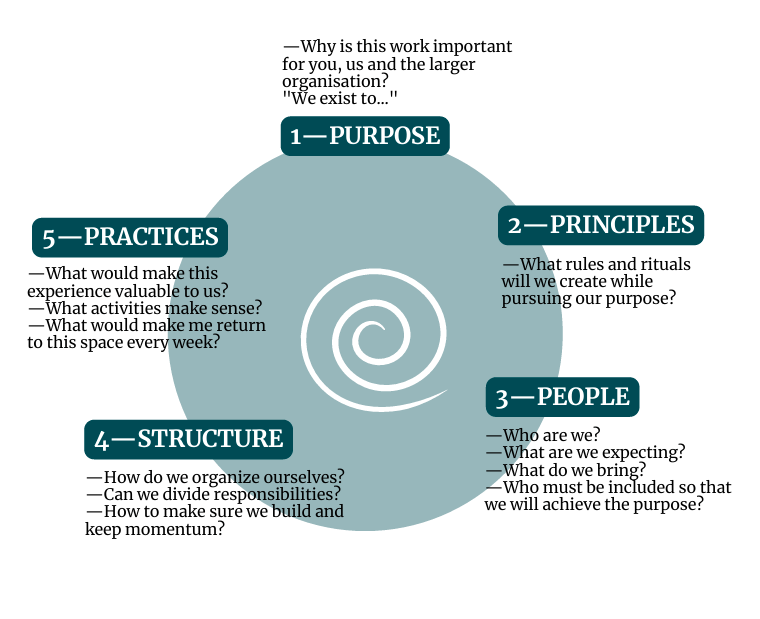
By workshopping these elements with early adopters, ambassadors, or core teams, L&D creates a space that people can make their own. This personal investment leads to deeper participation because employees recognise themselves in the design.
Creating an effective social learning environment: bringing it all together
Across this series, we have explored social learning from three angles: the foundational principles that make it work, the practical steps needed to scale it safely, and the design choices that make it self-sustaining. When these perspectives come together, they create a complete approach to building learning environments where collaboration becomes a natural part of work.
Start with purpose and safety
Before any collective learning initiative begins, two foundations must be in place: a clear purpose and psychological safety.
As Anamaria Dorgo emphasised, purpose sits at the overlap of organisational value and member value. Ask what business challenges need solving and why individuals should care. Without this clarity, participation will remain low no matter how well the technology is designed.
Psychological safety, as highlighted in the Mitchells & Butlers session, ensures that people feel comfortable contributing without fear of judgment. Clear participation guidelines and transparent reporting create trust. When employees know their input will be respected and any issues will be handled fairly, they engage more openly.
Together, purpose and safety answer two important questions: why should we gather, and is it safe to participate?
Design for diverse networks and broad participation
Charles Jennings’ research shows that strong, diverse networks accelerate learning. People who connect across departments, levels, and locations gain access to a wider range of perspectives and problem-solving approaches. His Social Network Analysis tool helps individuals and teams identify where their connections are too narrow or too reliant on a few people. Read more about the SNA tool in the first part of this series.
Mitchells & Butlers applied this thinking by creating larger, inclusive workspaces rather than niche groups. Broader spaces help messages reach more people, prevent information from becoming siloed, and encourage cross-team learning. As Todd Hotchkiss noted, posting every week keeps foot traffic high, while posting monthly causes engagement to drop off.
When designing collective learning, prioritise spaces that bring together people with shared goals but different experiences. Use features within your LMS to make these connections visible, such as tagging resources, linking posts to projects, or creating discussion threads.
Build through co-creation
Sustainable collective learning cannot be designed entirely by L&D and handed to employees. It must be co-created.
Dorgo’s five-element framework (purpose, principles, people, structure, practices) provides a way to workshop the design with early adopters. This process ensures that the learning space reflects what participants actually need rather than what L&D assumes they need.
Jennings reinforced this principle by highlighting teams as the atomic unit of productivity. When teams set development goals collectively, integrate reflection into meetings, and share results with one another, learning becomes embedded in how they work. This shared ownership makes learning sustainable because it is driven by the people doing the work, not imposed from outside.
Mitchells & Butlers demonstrated this through their approach to workspace ownership. Multiple group owners share responsibility for keeping spaces active, planning content, and responding to questions. When one person is unavailable, others maintain momentum. This distributed ownership prevents spaces from becoming dependent on a single individual.
Integrate learning in the flow of work
Collective learning only creates lasting impact when it connects to real work. Jennings outlined four ways to integrate learning and work: add learning to tasks, embed resources at the moment of need, extract lessons from completed work, and share insights with colleagues.
Mitchells & Butlers applied this through their apprenticeship programme. When formal coaching reduced, social groups helped apprentices stay connected, share experiences, and support one another through independent learning. This bridging of formal and informal learning kept knowledge alive when structured support stepped back.
Dorgo’s emphasis on value reinforces this point. If collective learning does not help people make progress in their work, they will not participate. Design activities that solve real challenges, capture lessons from live projects, or allow employees to test ideas with peers before applying them. When learning is tied to performance, engagement follows naturally.
Sustain through rhythm, recognition, and reflection
Collective learning requires ongoing attention to remain active. The three practices below help maintain momentum.
First, establish a predictable rhythm. Mitchells & Butlers planned content several weeks ahead, mixing questions, polls, videos, and updates. Consistency makes social learning a habit rather than an occasional activity.
Second, recognise contribution. Small acknowledgements, public highlights, or gamified rewards show that participation matters. Stuart’s Ambassador programme used points and prizes to make engagement visible. Even simple recognition, such as highlighting valuable posts or sharing learner stories, sustains interest over time.
Third, build reflection into the process. Jennings’ Three Question Card provides a simple structure for teams to review what they have achieved, identify what they would do differently, and capture lessons for future projects. When reflection becomes routine, learning deepens and spreads across the organisation.
Measure what matters: value, not activity
Finally, shift measurement from activity to value. Jennings advised moving away from tracking course completions and towards indicators of real improvement, such as faster resolution times, higher quality outputs, or stronger collaboration between teams. In essence, what is the impact?
Dorgo’s framework reinforces this by linking engagement directly to value. If people are not participating, the issue is not with engagement itself but with whether the activities create meaningful progress. Measure whether collective learning is solving the challenges it was designed to address. Gather feedback regularly, adjust activities based on what works, and be willing to stop practices that do not deliver value.
Making social learning sustainable in your organisation
Social learning becomes sustainable when it shifts from isolated initiatives to everyday practice. Across this series, we have explored how to make that shift happen.
We examined how social learning is grounded in strong networks and diverse connections, how psychological safety and clear structure allow it to scale safely, and how co-creation with a focus on value helps it sustain over time. When these come together, learning shifts from something that happens in formal programmes to something that happens continuously as people work.
To explore these principles in greater depth, join the Totara Community (which is free to join) to watch back sessions from the Learning with IMPACT event. There you’ll hear from Charles Jennings, Mitchells & Butlers, and Anamaria Dorgo, along with practical examples of how organisations are applying social and collaborative learning to strengthen performance.
For a concise summary of all sessions, download the key takeaway guide. It brings together lessons and actions from across the series, making it a valuable resource for any organisation.
Author
Fatima Nadeem
Date Published
03/12/2025
Article Type
Blog