

This blog post explores how the latest recertification workflows launched in Totara Version 20 (V20) help you efficiently manage recertification cycles and maintain compliance over time.
Why do recertification cycles matter for compliance and risk management?
In highly regulated industries such as healthcare, finance, hospitality and manufacturing, L&D certifications are essential for maintaining compliance. They provide clear, auditable proof that employees have completed required training and meet regulatory standards.
They help standardise competence across roles, support ongoing compliance through recertification, enable accountability and traceability, and reduce organisational risk – ensuring organisations can demonstrate compliance confidently during audits and inspections.
Why are multi-year recertifications so important in highly regulated environments?
Achieving a certification is a great way to document and prove your staff have the knowledge to stay compliant in a specific field or topic. But certifications are rarely a ‘once and done’ event.
This is because maintaining compliance over time is critical. Whether for patient and staff safety, or for continued operational success, certifications often have an expiry date and need renewing to meet either your internal or regulatory needs.
How do recertification workflows help L&D increase compliance and reduce regulatory risk?
Compliance requirements can be complex – they can span many roles, timeframes, and even multiple regulatory bodies.
Without structured, automated workflows, organisations risk missed renewals, inconsistent training records, and increased administrative burden. Managing complex certification requirements, for numerous roles and large numbers of staff, is challenging without the right technology to back you.
Well-designed recertification workflows ensure that certifications are renewed at the right intervals, refresher training is delivered proactively, and evidence is retained over several years – supporting audit readiness, patient safety (for example, for a healthcare-focused LMS), and workforce continuity.
They also reduce manual tracking, free up L&D and compliance teams, and provide leaders with confidence that staff remain qualified to practise on an ongoing basis, rather than a single moment in time.
What are certifications?
A certification is a series of learning activities, often covering several topics that relate to a particular theme, e.g. Health and Safety in the Workplace.
In Totara, a certification is a learning pathway that typically contains a series of courses, and sometimes seminars. An individual course may contain multi-modal learning activities, including interactive SCORM content, videos, scenario setting, quizzes and more.
Certifications allow you to adapt the pathway to the individual learners, keeping content relevant and focused. For example, new starters may be mandated to complete all learning activities within a course, and all courses within a certification.
More experienced learners, or those who demonstrate knowledge with high-pass rates on the initial course activities, may be able to skip other introductory-level topics.
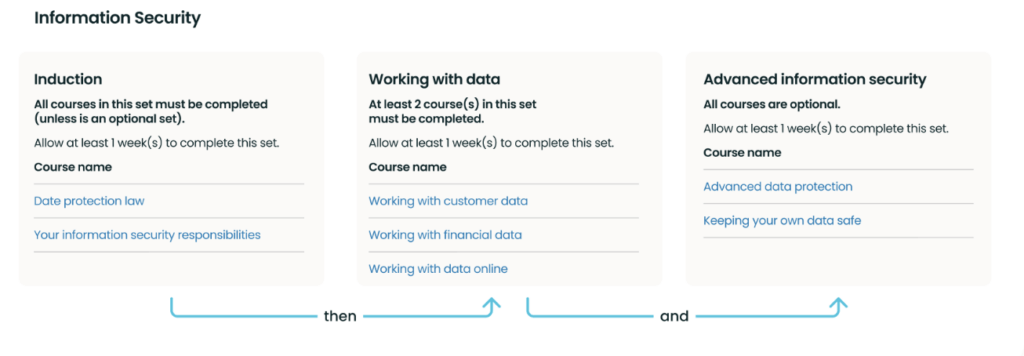
Learners can be automatically assigned and enrolled onto certifications to maximise L&D efficiency. This could be by job role, region, or by creating custom audiences, e.g. to assign onboarding to new starters.
Crucially, certifications have an expiry date, which allows your certifications to be time-bound. This makes certifications an essential tool for compliance management.
How do recertifications work in Totara?
Totara V20 introduces recertification workflows that offer flexible solutions to the challenge of managing multi-year certification cycles.
Admins can now automate and select an appropriate recertification path for learners.
Before: Admins had to create separate certifications for each group or expiry pattern.
When a certification expired, learners were always reassigned to the primary path. To reassign a certification expiry to a recertification path, admins had to manually intervene (requiring a status change to ‘certified window is open’ and then changing the due date).
In Totara V20: A single certification can manage multiple paths, expiry rules, and reinstatement behaviours.
1. Tailor certification renewal requirements to your exact requirements
You can now define which courses are required as refresher training to complete a recertification. For example, learners may complete an introductory path and full training in year one, then shorter, focused refresher paths in following years – or progress through paths as levels, building deeper knowledge over time.
This maximises compliance efficiency – freeing up staff time by focusing on the essential topics that matter most.
2. Improved visibility and progress status keep deadlines in mind
Improved UI means key certification milestones are visible to learners, with prompts to guide actions and accurately track progress.
Learners now benefit from a redesigned certification experience that makes it easy to see progress and what’s coming up next at a glance. Learners can clearly see what training they need to progress, preventing early or unnecessary training, ensuring all progress is correctly tracked and completed.
This reduces the chance of deadlines being missed. This is important as in sectors such as healthcare, where lapsed certifications can cause a drop-off in overall compliance rates. Managing this is an essential way of maintaining compliance.
3. Flexible reinstatement options if a deadline is missed
Reinstatement controls – If a learner misses a recertification deadline, you can now choose what happens next:
- Stay on the current path – the learner continues where they left off.
- Go back to the initial path – the learner restarts from the beginning.
- Choose a specific path – the learner is reassigned to specific location within the recertification path.
These options give compliance teams full control over how lapses are handled.
4. Improved admin workflows help manage complex requirements – efficiently and at scale
Managing certifications is now faster and clearer. Admins can now combine previously separate certifications into one structure, reducing duplication and ensuring consistent setup across teams.
5. Integrates into existing certification practices
The new workflows are fully compatible with Totara’s existing reporting, analytics, and notifications. This helps admins benefit from the new recertification cycles with minimal disruption integrating them into daily workflows.
See our Help Docs for more details on using certifications in Totara.
Author
Ashley Laurence
Date Published
27/01/2026
Article Type
Product
Solutions
Learn, Totara Suite