
According to recent industry reports, companies using collaborative technology see a 20 to 30% increase in innovation, while teams that collaborate effectively are 21% more productive. Yet these gains only materialise when collaboration is designed thoughtfully. In large or dispersed organisations, creating the conditions for meaningful peer learning becomes difficult.
However, when social learning environments are built with psychological safety and clear design principles, they can connect thousands of employees in ways that improve both individual capability and organisational performance. To help with this, in this article, we examine what it takes to build social learning spaces that work for everyone, regardless of role or location.
Later in this article, we’ll explore how Mitchells & Butlers, one of the UK’s largest hospitality groups, achieved this through MABLE, their custom LMS built on Totara. This article is part two of a three-part series on social learning, following insights from Charles Jennings on how collaboration shapes workplace development.
If you haven’t already, read the first part here.
Building psychological safety in social learning
Psychological safety is the foundation of any successful social learning environment. It creates a sense of trust where people feel comfortable sharing ideas, asking questions, giving feedback, or admitting mistakes without fear of judgment or negative consequences.
However, creating that level of trust is becoming harder in many workplaces. According to a study by Mental Health First Aid England and Henley Business School, there has been a steady decline in how many employees feel they can “bring their whole self to work” – falling from 66% in 2020 to 41% by the end of 2024. The same study found that while over 80% of employees believe this freedom is important, only 31% actually feel able to do so. This shows a widening gap between the culture organisations want to build and how employees experience it day to day.
Social learning spaces can help close that gap when designed intentionally. Features such as clear community rules, visible moderation, accessible reporting tools, and ongoing communication about how issues are handled show employees that their contributions are respected and protected. Psychological safety also lays the groundwork for effective collaborative learning, helping employees move from passive participation to active knowledge-sharing across teams.
Connecting social learning to daily work
For social learning to have a real impact, it needs to exist within the flow of everyday work. Employees learn most effectively when they can share experiences and apply new skills directly to the tasks in front of them.
Encourage learning through real projects
Employees often learn most when solving genuine workplace challenges. Social learning tools can turn those moments into opportunities for shared growth. Teams can post updates about ongoing projects, ask for input on specific issues, or document how they approached a difficult task. These activities transform experience into knowledge that others can use.
Creating digital spaces for this exchange means lessons are not lost when projects end. A discussion thread or short video summary can capture what went well, what could be improved, and what the team would try differently next time.
Support reflection as part of team practice
Reflection helps employees turn activity into learning. When people take time to discuss what they have done and what they might change, knowledge deepens and spreads. L&D teams can encourage this by adding prompts or short reflection questions in online workspaces. Managers can also make reflection part of team meetings or end-of-shift check-ins.
These discussions help individuals understand their progress and recognise how their work connects to wider organisational goals.
Link on-the-job learning with digital collaboration
Online platforms extend what people already do at work. When employees solve problems together, the LMS can record that interaction and make it visible to others. This helps organisations capture the informal learning that often goes unnoticed. Employees who post examples, share templates, or comment on a colleague’s solution create a shared knowledge base that benefits everyone.
Simple features such as tagging resources, linking posts to projects, or adding ‘lessons learned’ categories make these contributions easier to find. Over time, this builds a digital record of how teams learn through their work.
As these practices become part of daily routines, social learning becomes a habit across the organisation. The next section explores how Mitchells & Butlers achieved this on a large scale through a strong learning culture and a clear design strategy.
Applying social learning across large organisations: lessons from Mitchells & Butlers
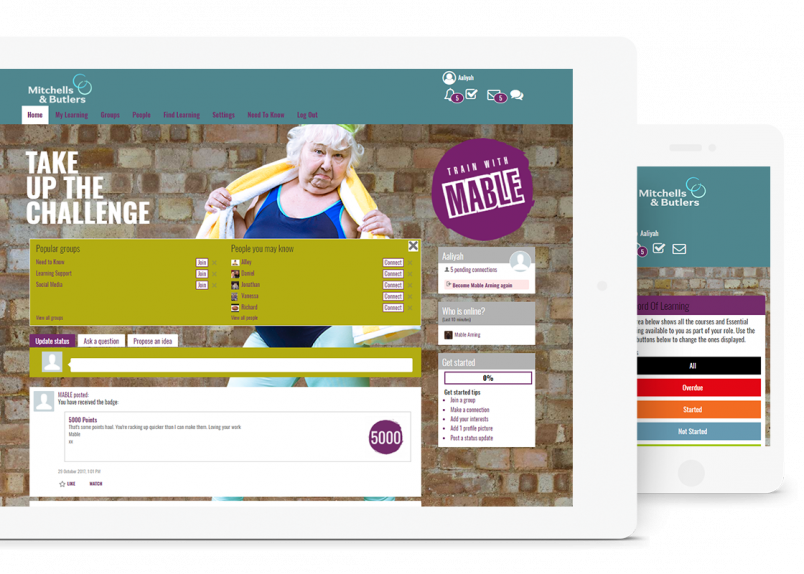
Mitchells & Butlers (M&B), one of the UK’s largest hospitality groups, manages more than 45,000 employees across pubs, restaurants, and bars. Their LMS, MABLE, built on Totara, shows how a large organisation can design social learning that feels personal, safe, and engaging. The lessons from their experience highlight how structure and community design can make collaboration part of everyday work.
Make the learning platform part of the culture
M&B treated their LMS not as a system but as a living part of their brand. MABLE became a recognisable character with her own tone of voice, appearing in messages, updates, learning prompts, and internal communications.
For other organisations, this approach highlights the value of humanising the learning experience. Giving your platform a clear identity or a familiar presence can increase recognition and encourage repeated engagement. Whether through storytelling, internal ambassadors, or branded communications, familiarity builds trust.
“She’s the face, the brand, the tone of voice. She’s everything that represents this LMS,” said Todd Hotchkiss, LMS Operations Manager at M&B. “People really get on board with this character. She’s dotted across the system and even speaks to us through our communications cascade.”
Create spaces that are open but structured
When M&B first explored social learning, they faced the same challenges many organisations encounter: managing safety, maintaining professionalism, and preventing fragmented discussions. Their solution was to bring collaboration inside the LMS, where activity could be visible and moderated while linking directly to learning.
They implemented:
- Clear participation guidelines to set behavioural expectations.
- Transparent moderation tools so content could be flagged and reviewed quickly.
- A focus on larger, inclusive groups that encouraged diverse input.
- Multiple group owners to share responsibility for keeping spaces active.
Other organisations can apply this by setting clear boundaries for participation and moderation before launch. Define who manages community spaces and make sure employees know that any flagged content will be reviewed quickly and fairly. Visible moderation and consistent communication create the psychological safety that keeps people contributing.
“Nine times out of ten, people want to share great ideas and what they’re proud of,” Hotchkiss explained. “And if something needs attention, the moderation tools handle it quickly.”
Design for continuous engagement
M&B kept their social spaces active by maintaining a predictable rhythm of posts and interactions. Group owners planned content several weeks ahead, mixing questions, polls, videos, and short updates. When someone was unavailable, others stepped in to keep the flow of communication steady.
Over time, this consistency made social learning a regular practice. Employees began checking in regularly, just as they would on familiar social platforms. Over time, discussions expanded beyond training to include creative ideas and reflections from the workplace.
Other organisations can achieve the same by:
- Planning a balanced mix of content formats.
- Encouraging team reflections after major projects.
- Recognising consistent contributors.
- Using small rewards or public acknowledgements to sustain participation.
“It’s better to have bigger groups of people than super niche ones,” said Hotchkiss. “When you post every week, you get loads of foot traffic. Post every month, and people start to fall off.”
Use social learning to bridge formal and informal learning
M&B implemented an apprenticeship programme that shows how social learning can support learners through independent stages of development. When formal coaching reduced, social groups helped apprentices stay connected. Learners shared experiences and compared ideas as they prepared for their final assessments.
This principle applies widely. When learners move from structured training to independent practice, social communities can keep knowledge alive and support continuous professional development across the organisation. L&D teams can open discussion threads for course alumni or encourage reflection journals that link learning to work performance.
Tailor technology to your organisation’s needs
M&B worked closely with their Totara partner to adapt their LMS to match how employees naturally communicate. They refined page layouts, made visual updates that reflected their brand, and added interactive features that rewarded engagement.
Their adjustments included:
- Pinning key resources in discussion groups.
- Allowing anonymous participation for sensitive topics.
- Adding recognition features such as avatars and visual badges.
- Customising notifications so employees saw updates relevant to their roles.
For other organisations, this shows the benefit of treating the LMS as a flexible tool rather than a fixed system. Technology should evolve alongside user behaviour. Even small adjustments like simplifying the interface or refreshing the design can improve engagement.
“Totara is so flexible – we could adapt it completely for our brand,” said their implementation consultant. “From privacy settings to avatars and notifications, every change made it feel more like our space and less like a traditional system.”
Moving social learning from intention to impact
Mitchells & Butlers’ experience shows that social learning succeeds when it becomes part of how people work. By creating trusted spaces, encouraging active participation, giving employees visible ownership, and aligning design with how people already communicate, M&B turned their LMS into a living network of learning and connection.
Every organisation can take a similar approach. Start by making learning spaces safe, link collaboration to real work, recognise contribution consistently, and use design to make participation feel natural. When people see that their input matters, social learning grows into a shared habit that strengthens capability and culture across the organisation.
You can watch the full session featuring Mitchells & Butlers on the Totara Community, which is free to join. To explore the wider lessons from all sessions, download the key takeaway guide for practical actions to help you use social learning to build stronger, more connected teams.
Author
Fatima Nadeem
Date Published
03/12/2025
Article Type
Blog